How can the deposits be removed?
Answers:
- Water soluble
deposits may be washed off with condensate or wet steam. - Water insoluble
deposits are removed mechanically after dismantling the turbine. - Experience shows that water soluble deposits are embedded in layers of water-insoluble deposits. And when the washing process is carried out, water soluble parts of the deposit dissolve away leaving a loose, friable skeleton of water-insoluble deposits which then break loose and wash away.
How can the detection of deposits in a turbine be made during operation?
Answers:
- Pressure monitoring.
- Internal efficiency monitoring.
- Monitoring exhaust steam temperature.
- Monitoring specific steam consumption.
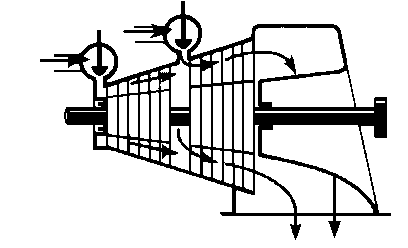
How can the disadvantages of the impulse turbine question 7 be overcome?
Answers:
- Velocity compounding
- Pressure compounding
- Pressure-Velocity compounding.
How can the fatigue damage on high-pressure blades be corrected?
Answers: Fatigue-damage on high-pressure blades arises due to vibration induced by partial-arc admission. This can be corrected by switching over to full arc admission technique.
How can the misalignment be rectified?
Answer: The bolts holding the flanges together are to be tightened. The coupling is to be checked for squareness between the bore and the face. At the same time axial clearance is to be checked. Using gauge block and feeler gauges, the gap between coupling faces 1800 apart is to be measured. After rotating the coupling-half 1800, the gap at the same points is to be measured. After this, the other coupling is to be rotated 1800 and the gap at the same points is to be re-measured. These measures should come within a few thousands of an inch. Dividing the coupling faces into four intervals, the distance between the coupling faces at this intervals is to be measured with the aid of a gauge block and feeler gauges. These gap measurements should come within 0.005 inch for proper angular shaft alignment. After proper alignment at room temperature, the two halves of the coupling are to be connected.
How can the problem of excessive speed variation due to throttle assembly friction be overcome?
Answer: The throttle should be dismantled. Moving parts should be checked for free and smooth movement. Using very fine-grained emery paper, the throttle valve seats and valve steam should be polished.
How can the speed variation be reduced by making a governor droop adjustment?
Answer: If the internal droop setting is increased, the speed variation will reduce.
How do the problems of vibration and fatigue arise with steam turbine blades?
Answers:
- These arise due to flow irregularities introduced because of manufacturing defects, e.g. lack of control over tolerances.
- System operating parameter, e.g. low flow may excite various modes of vibration in the blades.
How does deposit formation on turbine blades affect turbine efficiency?
Answer: About 500 g of deposits distributed more or less evenly all over the blading section can bring down turbine efficiency by 1%.
How does improper governor lubrication affect?
Answers:
- In the event of low governor oil level or if the oil is dirty or foamy, it will cause improper governor lubrication.
What is the remedy to it?
- The dirty or foamy lube oil should be drained off, governor should be flushed and refilled with a fresh charge of proper oil.
- In the event of low level, the level should be built up by make- up lube oil.
How does pressure monitoring ensure detection of turbine deposits?
Answers:
- Pressure of steam expanding in the turbine is measured at characteristic points, i.e., at the wheel chamber, points of pass-out, inlet/outlet of HP, IP and LP stages of the turbine.
- The turbine manufacturer provides the pressure characteristics in the form of graphs.
- At 1st commissioning, the user supplements these theoretical curves with those derived from actual measurements. These are actual pressure characteristics for a clean turbine. Now these pressure characteristics are compared with those obtained during operation in the later period.
- Under identical conditions, an increase in pressure shows the formation of deposits.
- For a steam throughput in the range 70-100%, an increase in wheel chamber pressure of more than 10% indicates severe blade depositions.
How does solid-particle erosion occur?
Answer: Solid-particle erosion, i.e. SPE occurs in the high-pressure blades. And it takes place when hard particles of iron exfoliated by steam from superheater tubes, reheater tubes, steam headers and steam leads strike on the surface of turbine blades.
How does the damage to turbine-blades tell upon the efficiency of the unit?
Answer: The damage to blade profiles changes the geometry of steam flow path and thereby reducing the efficiency of the unit.
How does the dirty safety trip valve trip the safety trip at normal speed?
Answers: Dirt may find its way to the safety trip valve and get deposited around the spring end cap end. This will block the clearance between the safety trip valve and the spring end cap. As a result the steam pressure in the spring cap gets lowered allowing the valve to close.
What is the remedy to it?
The spring end cap as well as safety trip valve should be cleaned.
How does the foreign-particle damage of turbine blades arise?
Answer: It occurs due to impact on blades by foreign particles (debris) left in the system following outages and become steam-borne later.
How does the internal efficiency monitoring lead to the detection of turbine deposits?
Answers:
- Process heat drop.
- Adiabatic heat drop.
- The process heat drop and adiabatic heat drop are obtained from a Mollier-Chart for the corresponding values of steam parameters - pressure and temperature - at initial and final conditions.
How does this modification reduce the vibration fatigue damage?
Answers:
- Joining the blade segments together at the shroud band increases the length of the arc-to a maximum of 360° that alters the natural frequency of the blade grouping from the operating vibration mode.
- This design has gained considerable success in commercial service.
How is a flyball governor used with a hydraulic control?
Answer: As the turbine speeds up, the weights are moved outward by centrifugal force, causing linkage to open a pilot valve that admits and releases oil on either side of a piston or on one side of a spring-loaded piston. The movement of the piston controls the steam valves.
How is oil pressure maintained when starting or stopping a medium-sized turbine?
Answer: An auxiliary pump is provided to maintain oil pressure. Some auxiliary pumps are turned by a hand crank; others are motor-driven. This pump is used when the integral pump is running too slowly to provide pressure, as when starting or securing a medium-sized turbine.
How is pressure compounding accomplished?
Answers:
- This is accomplished by an arrangement with alternate rows of nozzles and moving blades.
- Steam enters the 1st row of nozzles where it suffers a partial drop of pressure and in lieu of that its velocity gets increased. The high velocity steam passes on to the 1st row of moving blades where its velocity is reduced.
- The steam then passes into the 2nd row of nozzles where its pressure is again partially reduced and velocity is again increased. This high velocity steam passes from the nozzles to the 2nd row of blades where its velocity is again reduced.
- Thus pressure drop takes place in successive stages. Since a partial pressure drop takes place in each stage, the steam velocities will not be so high with the effect that the turbine will run slower.
How is pressure-velocity compounding accomplished?
Answers:
- It is a combination of pressure compounding and velocity compounding.
- Steam is expanded partially in a row of nozzles whereupon its velocity gets increased. This high velocity steam then enters a few rows of velocity compounding whereupon its velocity gets successively reduced. (Fig. 5)
- The velocity of the steam is again increased in the subsequent row of nozzles and then again it is allowed to pass onto another set of velocity compounding that brings about a stage-wise reduction of velocity of the steam.
- This system is continued.
Goto Page 4 Question & Answers Steam Turbines
www.massenginers.com